|
|
 |
British Colours 1747-1815, History
and Appearance << double click on pictures
throughout article to get larger view
>>
 |
Background British
Colours prior to 1747 Warrants of
1747, 1749, 1751 Col. Napier's
Drawings of 1747-1751 Instructions
of 1758 Warrant of
1768 |
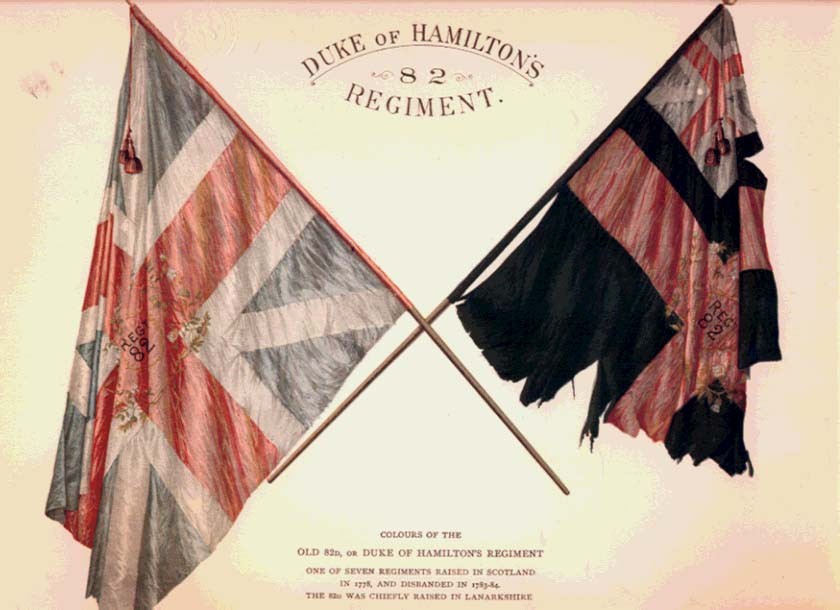
Prior to 1743 British Regiments
were generally known by the names of their colonels, and the
regimental colours, procured by each individual colonel, were
embellished with designs entirely at his whim, often with elements
of his personal or family coat of arms. In 1743 the first of a
series of Royal warrants and regulations standardized British
colours in several important ways that still obtained at the time
of the American Wars: 1) the first colour of each battalion was to
be the Great Union, 2) no color would display any designs except
those approved, and specifically not any part of the arms of
their colonels, 3) the second colour was to be the color of the
regimental facing and display a small union in the upper canton
next the staff, 4) except those specifically authorized royal or
"ancient" badges, colours would display in their centers the rank
of the regiment in a union wreath of roses and thistles on one
stalk. Warrants and drawings prepared in
1747, 1749, and 1751 reiterated the points made in 1743 and
included water-color paintings for those regiments allowed
"ancient" badges. (These dates are often cited individually, in
fact they refer to a single set of rules prepared by Colonel Robert
Napier, Adjutant General of the British Army, in 1747, delivered to
the Clothing Board 1749, and published 1751.) Each painting
included a label or scroll on the colour for regimental motto,
although few regiments had a motto at the time. It is unreasonable
to suppose, however, that flags were made, presented, and carried
with blank scrolls, and no original colour so made
has yet come to light. << double click on pictures throughout
site to get larger view
>> |
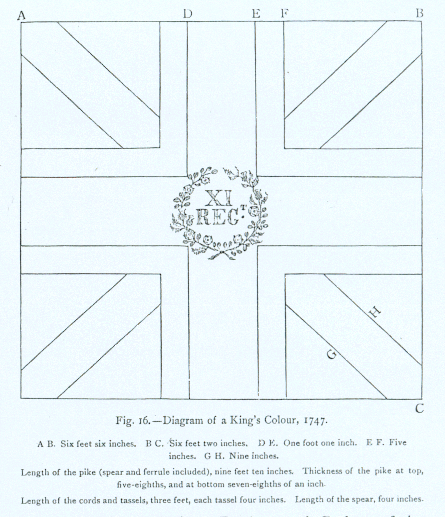
The
AG’s water-colors were not exact in their proportions, but Napier
also included a carefully drafted scale drawing that showed
the exact sizes of the component parts of the King’s colour,
including the union wreath, sized to fit entirely within the
thirteen inch wide cross of St George. The standard drawing did not
include label for motto. It is often mistakenly claimed that before
the Warrant of 1768 the size of the colours was not officially
stated; the scale drawing accompanying the 1751 regulation clearly
indicates both length and width. (See illustration) It also gave
precise dimensions for the pike, spear-head, and the cord and
tassels. Another document generally
overlooked was published in 1758. In that year fifteen new
regiments were created from the second battalions of those
regiments which had them, and a circular letter was published to
fix the facing colors and lace of the uniforms and the colours to
be carried. This was the first description of colours for regiments
faced in black (not as has been claimed, the warrant of 1768). This
document also specified that the rank of the regiment would be "on
crimson" in the center of the colours. Prior to this most
regimental colours had had their rank embroidered directly on the
silk field. The well-known warrant of 1768 basically restated the
provisions from the earlier documents and added two regiments to
those allowed "ancient" badges and special devices. It also reduced
the size of the colours by two inches on the pike, so that properly
made colours would thereafter be six feet six inches flying, and
six feet deep on the pike. |
 |
|
|